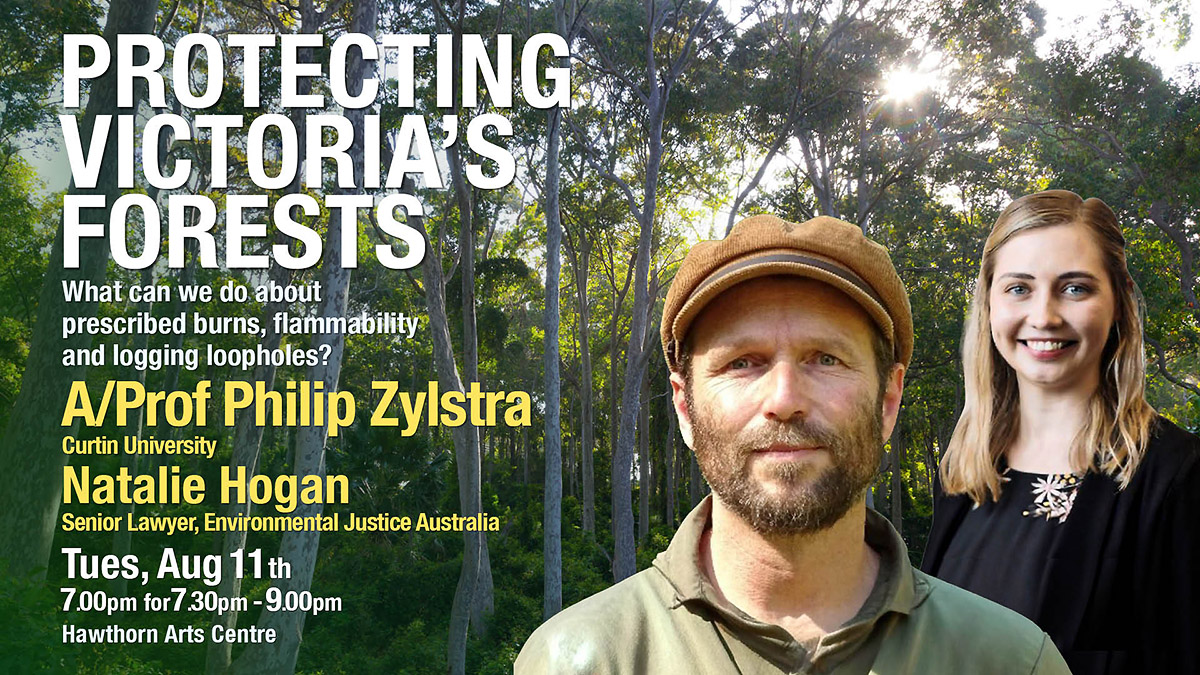
Protect our forests from planned burning and loophole logging
Come along on to the Hawthorn Arts Centre on Tuesday 11 August at 7pm to hear A/Prof Phil Zylstra and Senior Environmental Lawyer Natalie Hogan talk more about planned burning and loophole logging. Bring along your own questions to ask.
RSVP HERE

DOWNLOAD THE AGENDA FOR THE EVENING
Loophole logging
While so-called commercial native forest logging in Victoria’s Central Highlands and East state forests officially ended on 1 January 2024, more than two years later, logging continues in forests around our state under a number of different guises.
Forest By-Products Framework
In April 2026, DEECA and FFMV started rolling out a new framework about how “debris” removed from forests will be managed. This “debris” is timber, and the framework itself notes that this has “economic value”. Therefore it can be distributed to timber mills, among other places. Does taking timber out of a forest and selling it – for revenue – to a timber mill sound like logging?
Strategic Fuel Breaks
Forest Fire Management Victoria (FFMV) carries out “strategic fuel break” works, when, where and however they like, with no scientific basis, no assessment of threatened and endangered species in the area, no monitoring of whether what they’re doing is actually making anything safer for anyone, and no oversight. This is stealth logging.
Crucially, logging by FFMV is not subject to the Code of Practice for Timber Production. This means it’s not subject to the legal requirements that are intended to protect threatened species, and the State Conservation Regulator has no powers to intervene.
Read about the EJA’s legal concerns about the continuation of logging under other guises here.
Salvage Logging / Storm Recovery work
So-called “post-storm debris removal” involves logging after a storm has passed through a forest. It’s believed to be doubly damaging to the forest because just when a forest is recovering from a storm, it is targeted by this stealth logging. The flawed justification used for this type of logging is that the fallen trees are fuel for wildfires, but in fact, fallen trees do not promote fast-moving fires. In truth, salvaged logged forests are more flammable for a period of seven to 40 years after the forests have been cut and started to regenerate.
Clearly, there are many loopholes and we need to ask our MPs and candidates for the forthcoming election to legislate a permanent ban on native forest logging
Read more and take action at the Victorian Forest Alliance Loophole Logging page.