 Native forest logging has ended in Victoria right?
Wrong.
So-called commercial native forest logging in Victoria’s Central Highlands and East state forests officially ended on 1 January 2024, and the heavily subsidised, inefficient, costly and often illegal activities of the state owned logging agency, VicForests, ended when VicForests ceased to exist on 30 June 2024.
However, more than two years later, logging continues in forests around our state under a number of different guises.
Here’s what that looks like:
State Forest By-Products Framework
In April 2026, DEECA and FFMV started rolling out a new framework about how “debris” removed from forests will be managed. This “debris” is timber, and the framework itself notes that this has “economic value”. Therefore it can be distributed to timber mills, among other places. Does taking timber out of a forest and selling it - for revenue - to a timber mill sound like logging?
Perhaps it does, because it is.
The logging industry has effectively been folded into the State Environment Department.
Read the loophole framework here.
 Strategic Fuel Breaks
Forest Fire Management Victoria (FFMV) carries out “strategic fuel break” works, when, where and however they like, with no scientific basis, no assessment of threatened and endangered species in the area, no monitoring of whether what they’re doing is actually making anything safer for anyone, and no oversight. This is stealth logging.
Crucially, logging by FFMV is not subject to the Code of Practice for Timber Production. This means it's not subject to the legal requirements that are intended to protect threatened species, and the State Conservation Regulator has no powers to intervene. Which is why citizen scientists found a dead endangered Greater Glider next to a felled tree in the Yarra Ranges National Park AFTER logging was supposed to have ceased. It was the activity of FFMV.
Read about the EJA’s legal concerns about the continuation of logging under other guises here.
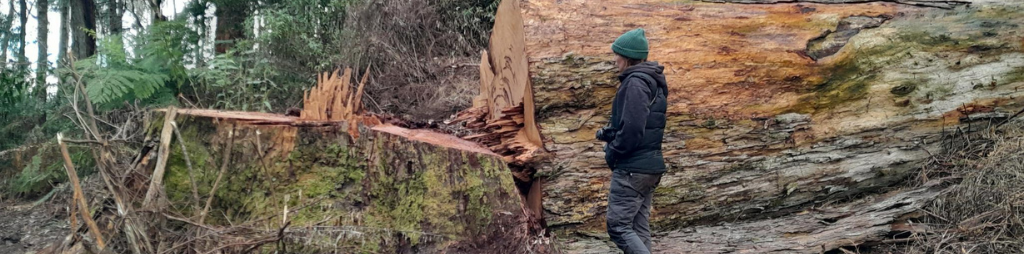
This image shows the cutting down of an old growth tree in the Yarra Ranges National Park near Noojee, for a fire break.
 Salvage Logging / Storm Recovery work
As well as stealth logging and the destruction of wildlife and habitats under the guise of creating a firebreak, there is another major category of stealth logging - that which is called “Post-storm debris removal” and involves logging after a storm has passed through a forest. It’s believed to be doubly damaging to the forest because just when a forest is recovering from a storm, it is targeted by this stealth logging. The flawed justification used for this type of logging is that the fallen trees are fuel for wildfires, but in fact, fallen trees do not promote fast-moving fires. In truth, salvaged logged forests are more flammable for a period of seven to 40 years after the forests have been cut and started to regenerate.
Read the science that debunks this terrible practice here.
Photos to the right and below show the results of salvage logging in the Wombat Forest.

Legislating a Permanent Ban on Native Forest Logging
The issue
So. As well as the forms of ongoing loophole logging above, we are also facing the risk of traditional, explicit native forest logging being allowed to restart.
The risk
- Logging licences can still be issued under existing legislation
- Private land logging continues
- Planning rules allow clearing under exemptions
- Outdated rules still treat native forest as a resource
- Public investment in ending logging is at risk of being undone
This creates a real risk that:
- Logging returns
- Forests are degraded through other pathways
- Government policy is undermined
Where the system is failing (specific policy gaps)
-
Forests Act 1958 and licensing framework
Still enables timber harvesting through forest produce licences -
Private land logging (major loophole)
Not included in the logging phase-out
Large areas of native forest remain exposed
Allowing logging on private land undermines the intent and integrity of the public forest logging ban
Planning system exemptions
- Under current planning controls:
- Logging can occur without a permit if it complies with the Code of Practice
- Clause 52.17 allows clearing of native vegetation, including for timber production
- Farming and Rural Activity Zones often don’t require permits for timber production
Code of Practice for Timber Production (2014)
- Outdated and weak
- Enables permit exemptions
- Not aligned with the end of native forest logging
No definition of “native forest” in planning law
- Native forest is treated the same as general vegetation
- Allows it to be logged under “timber production” rules
What we are asking for (specific legislative fixes)
Permanently prohibit native forest logging
- Amend legislation to ban logging across all land types
- Ensure no future licensing pathway exists
Remove licensing pathways
- Amend the Forests Act 1958 and regulations
- Prevent issuing of forest produce licences
Stop private land logging
Planning advice identifies a simple, effective pathway:
- Add a definition of “native forest” into planning schemes (Clause 73.01)
- Amend Clause 52.17 to prohibit removal of native forest for timber production
- Delete the exemption for “harvesting for timber production – natural established native vegetation”
This:
- Immediately stops logging of native forest on private land
- Removes discretion and loopholes
- Can be done through a Ministerial (VC) planning amendment
- Requires minimal changes and no complex new framework
Remove planning exemptions that enable logging
- Amend Clause 52.17 to remove permit exemptions tied to the Code
- Ensure native vegetation protections actually apply to forests
Update or override the Code of Practice
- Remove its role in enabling logging without permits
- Align it with the logging phase-out
Exclude all extractive industries from forests
-
Ensure legislation and policy explicitly prohibit:
- Logging
- Salvage logging
- Mining and exploration
Why this approach works
- The private land fix is fast, simple, and legally clear
- It aligns policy with the government’s stated position
- It removes ambiguity and future risk
Bottom line
Without these changes:
- Logging can return at any time
- Forest destruction continues through loopholes
- The transition away from native forest logging is incomplete (it must be finished by enshrining full legal protection for forests)
We are asking for targeted legal reforms to make the end of logging permanent, enforceable, and irreversible.

SUPPORT OUR CAMPAIGN
Victoria’s forests are still standing because people like you have stood up for them.
Most Victorians don’t realise what’s at stake — which is why your voice and actions this year are so important. As we head toward the state election in November 2026, standing up now is the only way to defend the forests and the wildlife that depends on them.
Commitments to new National Parks have been withdrawn, funding and experienced staff have been cut from Parks, and biodiversity support has been slashed.
Public support for forests remains strong, but right now, Nature needs people power more than ever.
That’s why the Victorian Forest Alliance is stepping up, and why we need your financial support to do this.
Communities across Victoria are pushing back against destructive practices and speaking up for the places and wildlife they care for. Momentum is building, and the next chapter is ours to shape.
Collectively, we, the member groups of the Victorian Forest Alliance, are using our voices and our actions to:
- survey for endangered species in threatened forest habitat
- promote better ways to protect homes and forests from fire
- end the unnecessary and unscientific planned burns that are ravaging our forests
- collect evidence of the damage done by planned burns
- challenge species loss and habitat destruction in the courts
- train community members to use social media more effectively
- campaign to State Cabinet to make forest protection a priority election commitment
- call a halt to clearing for mining in native forests
- stop the conversion of native forest to pine plantations
- promote ecologically-based rehabilation of damaged forests and habitat
Please support this crucial and inspiring work by donating to the Victorian Forest Alliance.
Every dollar you donate will go towards the fight for our forests.