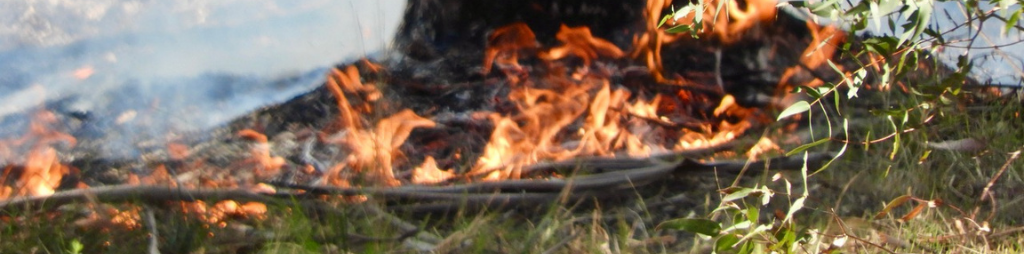

We urgently need to rethink how we protect our forests and communities from bushfires, especially as our climate heats up. Planned burns don’t stop bushfires.
Planned burns have become the go-to solution to the issue of fire management, but they actually make forests more flammable.
Study after study confirms that repeatedly burning the bush destroys habitat, kills wildlife, dries out forests, and when plants grow back after these man-made fires, they are low-level, scrubby plants that are much more flammable than the moist undergrowth in forests that have been left alone.
Apart from making forests drier and easier to burn, planned burns harm human health. More people die from smoke inhalation than from bushfires.
Man-made bushfires, or planned burns, kill endangered species and threaten biodiversity. They destroy hollow-bearing trees, the older trees that numerous species, including the Greater Glider, need to live in.
These planned burns are mostly conducted far away from human habitation – they are not managing any threat to life or property, and they are making the effects of climate change worse.
The intersection of burning and logging
To add to the destruction, before planned burns are conducted, trees are often cut down under the guise of “hazard removal” – which means that those trees, once they are burned, could potentially become a hazard to fire management staff, so they cut healthy trees down in advance of the burn. This loophole logging now its incentivised because in April 2026 the Victorian government changed its laws to make it legal to sell this wood from supposed “hazard removal”, in its new State Forest By-Products Framework.
This means that incentives encourage the destruction of the forest, rather than the protection that was intended by the supposed end to native forest logging in Victoria. The Victorian government also allows further loophole logging to continue by calling it "strategic fire breaks". This results in destroying the same amount of forest that the logging industry once did – but without any oversight.
Thanks to planned burns, 122,000 hectares were lit up in 2024. Just under 300,000 hectares of state forest, national park and other lands were slated for deliberate burning in 2025. By contrast, logging affected 50,000 hectares over the whole of the last 13 years of native forest logging in Victoria.
What are we doing about it?
The VFA campaigns tirelessly for this dangerous, destructive and pointless practice to end.
The cumulative effects of native logging have caused landscape scale forest destruction, permanent forest loss, severe damage to forest structure, hugely increased flammability, loss of resilience, biodiversity and threatened species supporting habitat. If it continues, planned burning and its cumulative effects take on a scale that makes these combined burning and logging losses unfathomable.
The least flammable forests are ones that are undisturbed. We need to identify, maintain and expand long-unburned patches of forest, as a fire safety mechanism. We also need to protect what’s left, restore what has been damaged, and find other ways to keep ourselves safe from fires – such as rapid detection and suppression using drones and monitoring.
Planned Burns are a massive threat to our native forests. We are calling for an immediate Pause and Review of Forest Fire Management Victoria's burn operations, and the redirection of FFMV funding into rapid detection and suppression technologies.
Enough is Enough- Stop the destruction of Grampians National Park Report
Precious, mature stringybark woodland and heathland in Grampians National Park near Dunkeld is being bulldozed now (September 2026) by Forest Fire Management Victoria in preparation for planned burning. This is one of the last remaining areas of unburnt, mature habitat following the devastating 2024–25 fires, yet instead of protecting this vital refuge, more burning and clearing is being proposed. The works are already destroying hollow-bearing trees, orchids and other understorey, with serious implications for wildlife and the park’s natural and visitor values.
Download Enough is Enough to read the full report
Victoria’s unscientific and ineffective planned burns program is environmental vandalism on an industrial scale.
We need your support to stop this devastation. We need a Pause and Review of this fire management travesty.
Our Fire Resources page has a wealth of references, videos, and readings to support all the claims made on our website and through our campaigns. Head over there for a deep dive into the research.

Forest biodiversity is collapsing
Australia has one of the highest extinction rates in the world. Many forest-dependent species rely on large old trees and hollows for shelter and breeding, which take at least 120 years to develop but can be destroyed in a single fire. Government research found that around one quarter of hollow-bearing trees reached by planned burns collapse, a 27-fold increase in risk compared with unburnt trees. Each tree lost can wipe out habitat for dozens of species, with some populations dropping nearly 50%. Planned burns are repeated on cycles of varying lengths, meaning this destruction is exponential.
Fire management works are often documented in threatened species habitat, based on outdated data, ignoring recent observations, and recognising ecological damage only after it occurs. The result is a chain of cause and effect: biodiversity decline → dependence on ancient trees → destruction from burning → weak oversight. Without urgent reform, Victoria’s forests and the species that depend on them face mounting, long-term losses.
See: Lindenmayer & Taylor 2020; Lindenmayer et al. 2022, 2024; Bluff 2016.
Reform must be led by First Nations peoples, recognising their deep cultural, spiritual and custodial responsibilities to Country, and embedding their leadership in the care and management of all landscapes.
Planned Burns and Bushfire Risk
There are many scientific studies showing that planned burns are of little use for mitigating bushfires.
See: Land Management Practices Associated with House Loss in Wildfires.
Planned burns can increase the fire danger within a few years because of the pulse of regrowth that follows. As the understorey grows back after a fire, becoming taller and denser, fire risk greatly increases for the next 37 to 49 years.
See: Old forests three times less flammable.
Mature forests slow fires — broad-scale burning increases risk
Repeated broad-scale burning is making Victoria’s forests more flammable and destroying critical wildlife habitat.
Older, less disturbed forests are naturally less flammable. They have:
- Cooler, moister microclimates
- Denser canopies that slow fire spread
- Higher biodiversity, carbon storage, and water retention
Victoria’s current fire strategy focuses on frequent, large-scale burning. The problem: there’s simply too much forest to burn every 4–5 years, and repeated high-intensity burns fragment habitat, destroy species, and actually make forests more flammable over time. Hollow-bearing trees, rare species, and long-unburnt forest areas are particularly at risk.
Science supports smarter approaches that suppress fires quickly without destroying ecosystems:
- Rapid fire detection
- Aerial surveillance and remote sensing
- Fast initial attack
- Targeted protection of communities and homes
Protecting mature forests and reducing broad-scale burning is safer, more effective, and better for biodiversity, carbon, and water resources.
See: Bradshaw, Lindenmayer & Zylstra 2022; Zylstra et al. 2016, 2018; Yebra et al. 2021.
Webinars on Planned Burns and Fire Science
Watch our webinars below with Prof. Phil Zylstra , Prof. David Lindenmayer, and Karl Just to learn a bit more on the science and history of planned burns.
Download a summary sheet of the webinar
Download a summary sheet of the webinar
Download a summary sheet for the webinar
Want to dive deeper? Head to our Fire Resources page.
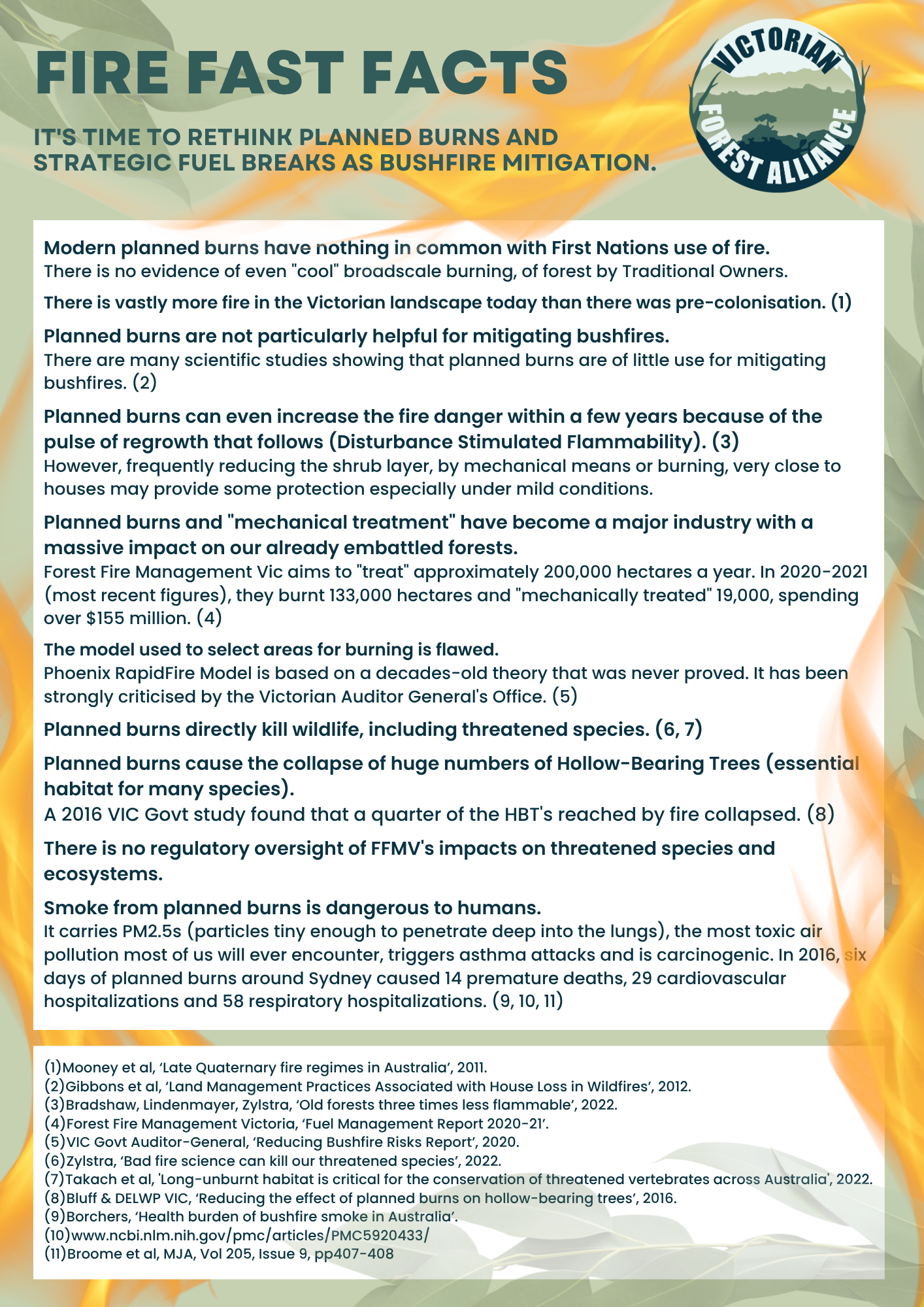
For more information about the science challenging planned burns, download our Fire Fast Facts brochure.

What about First Nations use of fire?
Modern planned burns have nothing in common with First Nations use of fire. There is vastly more fire in the Victorian landscape today than there was pre-colonisation. There is no evidence of even "cool" broadscale burning, of forest by Traditional Owners.
Conflating planned burns and forms of traditional fire management, including cultural or ecological burns, is dangerous and misdirected. We aren't campaigning against traditional fire management, or the use of any fire in landscapes. We're campaigning against a very specific type of forest fire management, called a 'planned burn'.
Have a listen to Prof. Phil Zylstra's exploration of these ideas, with particular attention to the dialogue between Zylstra and Wurundjeri elder Uncle Dave Wandin:
Impacts on Human Health

Smoke carries PM2.5s (particles tiny enough to penetrate deep into the lungs), the most toxic air pollution most of us will ever encounter, triggers asthma attacks and is carcinogenic.
In 2016, six days of planned burns around Sydney caused 14 premature deaths, 29 cardiovascular hospitalizations and 58 respiratory hospitalizations.
See:
• Health Burden of Bushfire Smoke in Australia.
• Function of PM2.5 in the pathogenesis of lung cancer and chronic airway inflammatory diseases.
• Health burden associated with fire smoke in Sydney, 2001–2013
Planned Burn on Gunnai-Kurnai country, Feb 2025.
Photo: Irene Proebsting
Impacts on Biodiversity
Planned Burns have a horrific impact on biodiversity. They destroy many hollow-bearing trees, which are crucial habitat for many of our endangered species. They also directly kill wildlife, and can scorch ecosystems at a severity that takes many years to recover from.
Long unburnt habitat is crucial for the conservation of many species, plant and animal alike. As climate change makes bushfire seasons longer and more severe, maintaining these patches of unburnt, fire resistant mature forest is increasingly important.
Read the links below or head to our Fire Resources page and watch some of the webinars.
• Bad fire science can kill our threatened species. It’s time to cooperate with nature.
• Long-unburnt habitat is critical for the conservation of threatened vertebrates across Australia.

Damage to hollow-bearing habitat trees
A 2016 Victorian government study found that 25 per cent of hollow-bearing trees that the fire reached, collapsed during planned burns. A further 27 per cent were damaged. If a planned burn is conducted every 7 to 12 years, which is the government's ideal burn cycle, this can mean that most hollow-bearing trees could be lost from that forest within 25 years.
See: Reducing the effect of planned burns on hollow-bearing trees.
"Hazardous tree removal"
This article describes an example of the practice of felling trees, associated with planned burns programs, and the consequences for wildlife.
See: Endangered greater glider found dead next to department’s felling site.
The scale of planned burns devastation
See: Table 11 of the 2023-24 annual report of Forest Fire Management Victoria for details of the 122,291 hectares which they burnt that year.
Our Fire Resources page has a wealth of references, videos, and readings to support all the claims made on our website and through our campaigns. Head over there for a deep dive into the research.
Our Solution
We're urging the government to increase funding for rapid detection and response capability, so that small fires are put out before they become large. This is already an effective strategy. Over the 2024-2025 summer, more than 9 in 10 Victorian fires were contained as a result of the first attempt at suppression. And we can do this better.
DEECA sets a target that 80 % of new fires be contained under 5 hectares, yet crews routinely exceed this, containing 90 %+ of small fires through rapid detection and initial attack alone. Despite this proven success, resources continue to flow into broad-scale, high-intensity planned burns instead of expanding early detection and rapid response capacity. This is a deliberate strategy to maintain planned burns activity, rather than to reduce risk — a choice that increases forest flammability, fragments habitat and threatens biodiversity.
$160 million was spent on planned burns in 2023-2024. This is a massive spend that should be directed instead to improving rapid detection and suppression.

Want a crash course on the reality of planned burns and current bushfire management strategies?
Download our Fire Fast Facts sheet.


Citizen's Reporting on Planned Burns
See a planned burn get out of control? Observe some dodgy conduct by Forest Fire Management Victoria? We want to hear about it!
Head over to our Citizen's Reporting on Planned Burns page and make a report.